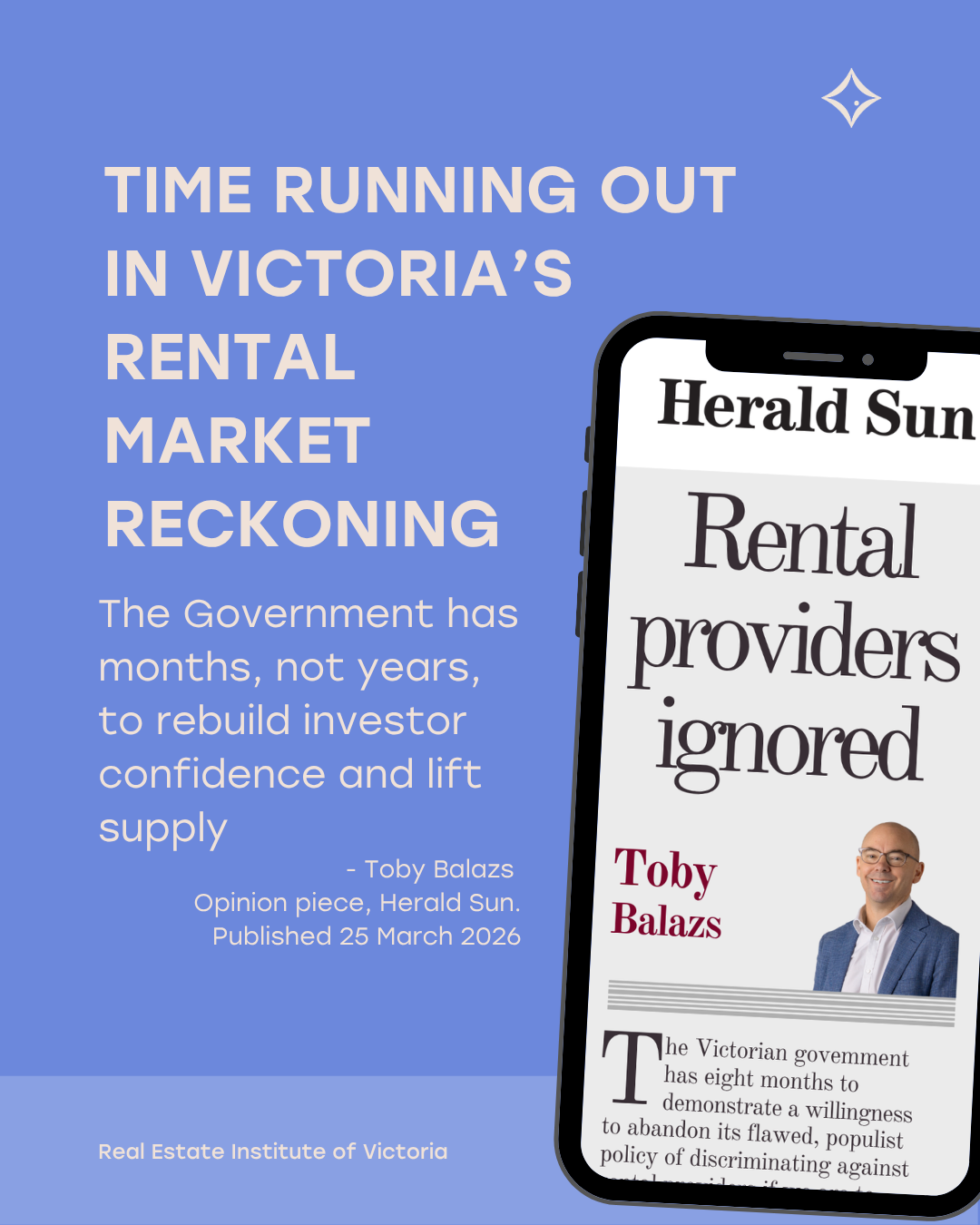
OPINION EDITORIAL
Published in Herald Sun on 25/03/2026
The Victorian Government has less than nine months to demonstrate a willingness to abandon its flawed, populist policy of discriminating against rental providers if we are to believe it capable of enabling renters to finally emerge from their residential property wilderness.
After all, if one can reasonably expect an election year to prompt some incumbent introspection, then the dire state of Victoria’s rental market must surely be front of the Victorian Government’s mind.
And if it’s wondering where to start, how about asking itself a simple question: Why would a government that is seeking to increase desperately needed rental property supply continue to alienate rental providers, whose ongoing investment is critical to achieving this?
Surely, the answer cannot be that there are cheap political points in a policy, however flawed, which plays to the narrative that all investors are “rich”. Not when Australian Taxation Office data shows that the top rental provider occupations are registered nurses, office administrators, primary or secondary school teachers, IT managers, electricians, and sales assistants.
Of course, this comes after a decade of over-regulation and investor targeted tax reforms, under the Andrews-Allan Labor Governments, that have failed to materially improve the plight of Victoria’s renters.
It’s important to note that this isn’t to overlook critical regulatory changes – including the likes of mandatory annual smoke alarm checks and ensuring rentals meet minimum standards when properties are advertised – that have served to protect fundamental renter rights and been welcomed by the Real Estate Institute of Victoria (REIV).
But, rather, to focus on a spluttering Victorian rental market and a policy approach that has failed to address the top two priorities – in availability and price – for any renter.
Consider, for example, damning data from Homes Victoria that shows a net decline of more than 22,000 active rental bonds between September 2023 and September 2025. So too, that rental vacancy rates across metropolitan Melbourne and key regional centres have remained persistently below the golden three per cent target.
Not that this should come as any great surprise. Or, at least, not when you factor in industry feedback now ranking Victoria as the least accommodating state for property investors, prompting a decline in investment sentiment, a sell-off of rental properties and a shrinking rental pool.
And the fact that this is the result of a relentless 10-year period of rental regulation and property taxation policy initiatives that have served to increase regulatory complexity and holding costs for rental providers.
Indeed, one need only reflect on the 150 distinct rental market reforms introduced over the last decade that have impacted property investor ownership and rental provision. Not to mention that REIV research shows that land tax payable on a median-priced house and unit has more than doubled since 2020, even as median values have remained broadly stable or declined.
But, now for the good news…there’s still time for this Victorian Government. And it all starts with the upcoming Victorian State Budget, which looms as a critical opportunity to change course on rental market policy and rebuild investor confidence ahead of November’s election.
The REIV has called on the Government, in its recently released budget submission, to place a freeze on increases to property-based taxes, and avoid expanding existing property taxes, charges and other fees. The Institute also recommends targeted tax reform – including incentives to drive medium-density build-to-rent housing and land tax concessions to encourage long-term leases – to boost rental supply.
Let’s hope the Government is listening.
For, after ten years of flawed rental market policy and already two years into the promised delivery of Victoria’s Housing Statement, Victorian voters must start to see a Government that can recognise that’s what good for rental providers is most often good for renters.
By Toby Balazs, Chief Executive Officer, Real Estate Institute of Victoria