The AML/CTF Summit, held at REIV HQ in Abbotsford on 24 April, was a sold-out success that equipped agencies with practical guidance ahead of their upcoming anti-money laundering obligations. With real estate businesses set to fall under AML/CTF compliance requirements from 1 July 2026, professionals are being encouraged to enrol with AUSTRAC as early as possible to prepare for the changes. 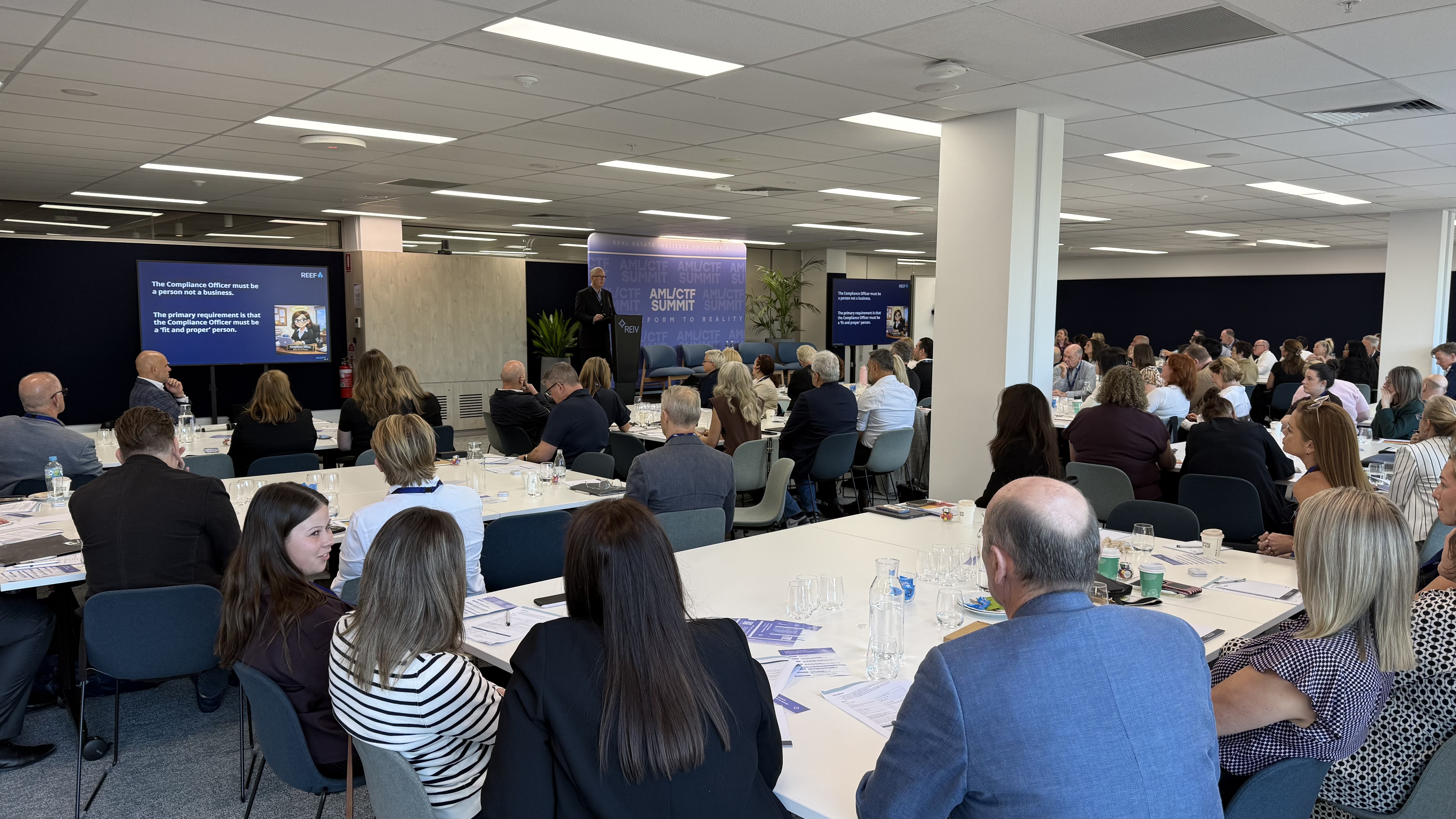
Opening the summit, REIA CEO Scott Rollason reflected on recent advocacy successes driven by collective efforts across the REIs. Contributions through the Rules & Guidance Working Group and formal submissions have resulted in several key amendments to the framework, including allowing agents to rely on a buyer’s conveyancer for aspects of customer due diligence (CDD), extending delayed CDD timeframes from 15 to 28 days, and recognising that agents have satisfied their obligations where they have taken reasonable steps and property documented their efforts, even where a counterparty fails to cooperate. Scott emphasised AUSTRAC’s receptiveness to industry feedback and its ongoing consultative approach. He noted that regulators have acknowledged the unique role real estate professionals play in supporting anti-money laundering efforts, with advocacy focused on minimising duplication and aligning Australia’s regime with other developed jurisdictions.
William Morris, Acting National Manager of Policy, Rules and Guidance at AUSTRAC, led a practical session on identifying money-laundering risks through case-based scenarios. William highlighted that real estate is one of the biggest money-laundering risks globally and is likely to be the largest in Australia. He emphasised that real estate professionals should enrol as soon as possible, clarifying that registration is not required in the real estate sector. He reinforced that AUSTRAC’s approach is centred on preparedness rather than perfection, highlighting that low-risk customer checks are expected to be relatively streamlined, generally taking between 10 and 15 minutes. He also clarified that real estate professionals are required to report suspicious transactions rather than stop them, outlining how tools such as the program starter kit and Politically Exposed Person (PEP) Checks can be applied in practice.
From an operational perspective, Bryan Wilcox of the Real Estate Employers’ Federation (REEF) outlined the role and requirements of a compliance officer. He stressed that the position must be held by an individual, not a business, who is ‘fit and proper’, operates at a managerial level, and has sufficient authority, independence, and access to compliance resources. His session also explored practical scenarios where oversight is critical, covering different applications of a compliance officer’s role.
Rochelle Ives of FirstAML provided an overview of core AML/CTF obligations, including the distinction between initial setup requirements and ongoing compliance expectations. She highlighted how technology solutions can streamline customer due diligence processes, while emphasising that AI tools cannot fulfil the role of a compliance officer. Demonstrating FirstAML’s platform, she highlighted efficiencies in verification processes and dedicated workflows, as well as its ability to support handling complex CDD scenarios.
The summit concluded with a panel of industry and compliance professionals sharing their perspectives on preparing for the incoming reforms. Woodards’ Luke Piccolo observed that while the changes may initially pose challenges, they will ultimately strengthen compliance, trust, and customer assurance across the market. BigginScott’s Nikki Cambridge noted the importance of aligning residential property transactions with broader compliance frameworks, while Allard Shelton’s Bernadette Gooda highlighted the reputational benefits of bringing Australia in line with global standards.